Friday, March 23, 2007

Latest UFO Sighting Reports

Here are the latest UFO Sightings reported to UFOs/Aliens.

Alabama-03-14-07-Witness was driving to his friend's house on Chalkville Road on a clear night. He soon spotted a brilliantly lit triangular-shaped object directly in front of him. Object was turned where the distinctive triangle shape was easily seen. Thinking it might be a plane, even a stealth, was easily dismissed because object had a large, red, circular light directly in the center. He watched the object for quite some time, and two other motorists also saw it.

Arizona-03-13-07-Witness saw three lights in the sky, at first moving together until one moved away, disappeared, then reappeared. The next night the object also appeared, witnessed also by niece across the street from observer's home, who saw the UFO first. Four other family members also witnessed the object / lights on the same night.

California-03-14-07-In the small town of Buttonwillow, witness was sitting on his porch at home, when he noticed what he first thought was a jet plane. Upon closer inspection, he noticed that the object had no wings or tail. Object was very shiny silver, and an amazing three football fields long. The long cigar-shaped object had three protuberances on the top.

Georgia-03-15-07-Witness looked toward backyard, and saw a UFO at treetop level. The object had bright lights, and was a bluish-silver color. The object has a triangular-shaped light in the middle of an egg-shaped bottom. UFO was so low, witness states he could almost touch it. He could hear a humming noise as it moved over his head. Object eventually moved out of sight.

Illinois-03-10-07-The witness was in a hot tub at night, and saw a triangular-shaped UFO fly over his position. It was moving at very low altitude. Object was large, very dark in color, and more arrowhead shaped. Witness reported the sighting to local police department, but they had received no other reports of the slow moving, silent object.

New York-03-13-07-Witness spotted a bright, shining object which hovered in one spot for two minutes. Event occurred as witness was sitting at computer, while his wife was in the kitchen. They both heard a a low-pitched, rumbling sound from outside. The husband kept having the feeling that he was being watched, which caused him to go outside, and at that time, he witnessed the UFO. There had been a lot of air traffic over their house, which was very unusual.

Thursday, March 22, 2007

Extremely bizarre skin condition in Eastern Europe

While I was surfing, I stumbled upon WFMU's Beware of the Blog, where I found this strange story of a missionary that encountered a bizarre skin condition in Eastern Europe. That poor, poor man! Can you imagine having this kind of condition throughout your entire life?

Easterneuropeskincondition1c A friend of mine has a relative who is a missionary in Eastern Europe. He recently shared photographs and the story of a man he is caring for, who has an extremely bizarre skin condition. The man has keratin-like matter growing out of the skin on hands and feet, which started when he was young, and very slowly continues to spread and grow. The areas begin as skin lesions, and the matter sprouts from those spots. The growths are very difficult to remove, and the man has so far just had to learn to live with it. There are a few medical precedents to this man's case, but nothing is certain until more tests are done. In the meantime, the missionary is helping to make life easier for the man. Click "continue" below for more photos. The missionary writes...

"I found this man, and other than his hands and feet, he looked and seemed in good health. As best as I could gather these growths began when he was 14 years old, and began in the area of his wrists. The skin on his wrists and the back of his hands resembles that of a hedgehog - hundreds of spike like growths. The problem is much more severe on his palms and fingers where the growths resemble very much that of nails infected with a fungus. The growths have that same texture, smell and feel. I cut a number of the largest growths off, most of witch did not bleed. Some of the smaller growths did bleed a small amount and he seemed much more sensitive to the cutting of the smaller growths. I soaked his hands first in 3 WEA (phenyl mercuric nitrate) and then began. The 3 WEA did help to soften the growths but they still took time to cut through, or sand down, but it worked just as it does with these types of nails on normal hands or feet. I was able to pull many of the smaller growths off applying steady pressure and slowly pulling. But after 1.5 hrs there was not a noticeable change as there are hundreds and hundreds of growths. There was also quite a bit of dissolved material in the bucket of 3 WEA after we finished.

On his feet I did not cut anything, but tried two different solutions of salicylic acid, one a bit weaker than the other, and also a freeze spray wart remover.

I met his mother and brother (they all live together) and their skin looked very normal. They all eat the same foods and he and his brother sleep in the same bed.

It has grown slowly but steadily but has not spread to other parts of his body, just a bit below his knees on his legs. He has other skin growth (many would be skin tags) on his face, and some moles on his chest. The growths are not as bad on his feet but I was told that more than 10 years ago many we cauterized off his feet, and they did not return. I think with repeated soaking and cutting most could be removed but other parts will I think need to be burned away in some form."

I emailed the missionary a few more questions:

Is there a medical term for this man's condition?
Doctors here have called it Lewandowsky-Lutz, though I have not been able to find any pictures of this condition to compare.

Has any analysis of the matter growing off of his skin been done?
There was 18 years ago, when they came up with the name of what they thought it was. He has not been treated since then.

When do you understand that this started with him?
He is now 38 and it started when he was 14, on one wrist. He never returned for treatments as he felt the first cauterizing was effective in that the growths did not return to that area, but felt they grew more quickly in other areas.

Does the man have any other unusual symptoms?
He appears healthy other than the growths. He has 15 skin tags on his face, and a wart in one ear.

Have there been any theories about this man's past, something he might have done, ingested, or places he's been to... that may have caused it?
As he says he did not do or eat anything his brother did not do or eat, and his brother appears to be perfectly normal, not yet. I am currently showing the pictures to veterinarians, as I am also considering that maybe this is something he got from an animal (pig, sheep, cow).

Does it look like the man's condition is treatable or curable?
Curable, I don't know. But with ongoing thorough cleaning, creams, soaking and cutting - it will be much better for him.

More photos (click for larger view):

Liar paradox

From Wikipedia


In philosophy and logic, the liar paradox encompasses paradoxical statements such as:

  • I am lying now.
  • This statement is false.

These statements are paradoxical because there is no way to assign them a consistent truth value. Consider that if This statement is false. is true, then what it says is the case; but what it says is that it is false, hence it is false. On the other hand, if it is false, then what it says is not the case; thus, since it says that it is false, it must be true.

To avoid having a sentence directly refer to its own truth value, one can also construct the paradox as follows:

The following sentence is true. The preceding sentence is false.

Versions through history

Epimenides and Eubulides

In the sixth century BC the philosopher-poet Epimenides, himself a Cretan, reportedly wrote:

The Cretans are always liars.

The Epimenides paradox is often considered an equivalent or interchangeable term for the "liar paradox" but they are not the same. It is unlikely that Epimenides intended his words to be understood as a kind of liar paradox and they were probably only understood as such much later in history. Moreover this statement is not a paradox when false, because no proof exists that all Cretans really are liars.

The oldest known version of the liar paradox is instead attributed to the Greek philosopher Eubulides of Miletus who lived in the fourth century BC. It is very unlikely that he knew of Epimenides's words, even if they were intended as a paradox. Eubulides reportedly said:

A man says that he is lying. Is what he says true or false?

Bertrand Russell

Bertrand Russell formulated the liar paradox in terms of set theory. He discovered this form of the paradox, known as Russell's paradox, in 1901. First, he conceived of a set that included other sets. An example of this is the set of all sets. By definition, all sets, including this set, are members of the set of all sets. He then conceived of the set of all sets that do not include themselves. He pondered if this set included itself, and realized that it does if it does not, and it does not if it does.

Alfred Tarski

Alfred Tarski discussed the possibility of a combination of sentences, none of which are self-referential, but become self-referential and paradoxical when combined. As an example:

  1. Sentence 2 is true.
  2. Sentence 1 is false.

He resolved this "liar cycle" by arguing that when one sentence refers to the truth-value of another, it is semantically higher. The sentence referred to is part of the 'object language,' while the referring sentence is considered to be a part of a 'meta-language' with respect to the object language. It is legitimate for sentences in 'languages' higher on the semantic hierarchy to refer to sentences lower in the 'language' hierarchy, but not the other way around. This prevents a system from becoming self-referential.

Variants of the paradox

The problem of the liar paradox is that it seems to show that common beliefs about truth and falsity actually lead to a contradiction. Sentences can be constructed that cannot consistently be assigned a truth value even though they are completely in accord with grammar and semantic

rules.

Consider the simplest version of the paradox, the sentence:

This statement is false. (A)

If we suppose that the statement is true, everything asserted in it must be true. However, because the statement asserts that it is itself false, it must be false. So the hypothesis that it is true leads to the contradiction that it is true and false. Yet we cannot conclude that the sentence is false for that hypothesis also leads to contradiction. If the statement is false, then what it says about itself is not true. It says that it is false, so that must not be true. Hence, it is true. Under either hypothesis, we end up concluding that the statement is both true and false. But it has to be either true or false (or so our common intuitions lead us to think), hence there seems to be a contradiction at the heart of our beliefs about truth and falsity.

However, that the liar sentence can be shown to be true if it is false and false if it is true has led some to conclude that it is neither true nor false. This response to the paradox is, in effect, to reject a common beliefs about truth and falsity: the claim that every statement has to abide by the principle of bivalence, a concept related to the law of the excluded middle.

The proposal that the statement is neither true nor false has given rise to the following, strengthened version of the paradox:

This statement is not true. (B)

If (B) is neither true nor false, then it must be not true. Since this is what (B) itself states, it means that (B) must be true and so one is led to another paradox.

This result has led some, notably Graham Priest, to posit that the statement follows paraconsistent logic and is both true and false. Nevertheless, even Priest's analysis is susceptible to the following version of the liar:

This statement is only false. (C)

If (C) is both true and false then it must be true. This means that (C) is only false, since that's what it says, but then it can't be true, and so one is led to another paradox.

Another interesting variation is:

The writer of this statement cannot verify it to be true

In this version, the writer of the statement cannot verify it to be true, because in doing so he makes it obviously false, but at the same time cannot verify it to be false, as this would make it obviously true. Anybody else except the writer, however, can easily see and verify the statement's truth.

Not a paradox

The statement "I always lie" is often considered to be a version of the liar paradox, but is not actually paradoxical. It could be the case that the statement itself is a lie, because the speaker sometimes tells the truth, and this interpretation does not lead to a contradiction. The belief that this is a paradox results from a false dichotomy - that either the speaker always lies, or always tells the truth - when it is possible that the speaker occasionally does both.

Possible resolutions

A.N. Prior

A. N. Prior asserts that there is nothing paradoxical about the liar paradox. His claim (which he attributes to Charles S. Peirce and John Buridan) is that every statement includes an implicit assertion of its own truth. Thus, for example, the statement "It is true that two plus two equals four" contains no more information than the statement "two plus two is four," because the phrase "it is true that..." is always implicitly there. And in the self-referential spirit of the Liar Paradox, the phrase "it is true that..." is equivalent to "this whole statement is true and ...".

Thus the following two statements are equivalent:

This statement is false
This statement is true and this statement is false.

The latter is a simple contradiction of the form "A and not A", and hence is false. There is therefore no paradox because the claim that this two-conjunct Liar is false does not lead to a contradiction. However, this argument is fallacious due to a semantic subtlety: The referents of the statements changed when they were conjoined. Neil Lefebvre and Melissa Schelein present a similar answer[1].

Saul Kripke

Saul Kripke points out that whether a sentence is paradoxical or not can depend upon contingent facts. Suppose that the only thing Smith says about Jones is

A majority of what Jones says about me is false.

Now suppose that Jones says only these three things about Smith:

Smith is a big spender.
Smith is soft on crime.
Everything Smith says about me is true.

If the empirical facts are that Smith is a big spender but he is not soft on crime, then both Smith's remark about Jones and Jones's last remark about Smith are paradoxical.

Kripke proposes a solution in the following manner. If a statement's truth value is ultimately tied up in some evaluable fact about the world, call that statement "grounded". If not, call that statement "ungrounded". Ungrounded statements do not have a truth value. Liar statements and liar-like statements are ungrounded, and therefore have no truth value.

Barwise and Etchemendy

Jon Barwise and John Etchemendy propose that the liar sentence (which they interpret as synonymous with the Strengthened Liar) is ambiguous. They base this conclusion on a distinction they make between a "denial" and a "negation". If the liar means "It is not the case that this statement is true" then it is denying itself. If it means This statement is not true then it is negating itself. They go on to argue, based on their theory of "situational semantics" that the "denial liar" can be true without contradiction while the "negation liar" can be false without contradiction.

Gödel's theorem

The proof of Gödel's incompleteness theorem uses self-referential statements that are similar to the statements at work in the Liar paradox.

In the context of a sufficiently strong axiomatic system A of arithmetic:

This statement is not provable in A. (1)

The statement (1) does not mention truth at all (only provability) but the parallel is clear. Suppose (1) is provable, then what it says of itself, that it is not provable, is not true. But this conclusion is contrary to our supposition, so our supposition that (1) is provable must be false. Suppose the contrary that (1) is not provable, then what it says of itself is true, although we cannot prove it. Therefore, there is no proof that (1) is provable, and there is also no proof that its negation is provable (i.e., there is no proof that it is also unprovable). Whence, A is incomplete because it cannot prove all truths, namely, (1) and its negation. Statements like (1) are called undecidable. We take for granted that all the provable statements of logic and arithmetic are true; Gödel showed that the converse, that all the true statements of a system are provable in that system, is not the case. (This does not mean that all true statements are not provable in some system or other. Additionally, there are systems, such as first-order logic, in which all true statements of the system are provable.)

Tarski's indefinability theorem, closely related to Gödel's Theorem, is a more direct application of the Liar Paradox, though there is no actual paradox involved; instead, the "paradox" simply demonstrates that all the true sentences of arithmetic are not arithmetically definable (or that arithmetic cannot define its own truth predicate; or that arithmetic is not "semantically closed").

Dialetheism

Graham Priest and other logicians have proposed that the liar sentence should be considered to be both true and false, a point of view known as dialetheism. In a dialetheic logic, all statements must be either true, or false, or both. Dialetheism raises its own problems. Chief among these is that since dialetheism recognizes the liar paradox, an intrinsic contradiction, as being true, it must discard the long-recognized principle of ex falso quodlibet. This principle asserts that any sentence whatsoever can be deduced from a true contradiction. Thus, dialetheism only makes sense in systems that reject ex false quodlibet. Such logics are called paraconsistent.

In popular culture

In the episode "I, Mudd" (Episode #41) of the original Star Trek series, Captain Kirk and Harry Mudd use the liar paradox to confuse and thus incapacitate an android who is holding the landing party captive.

In the 1973 Doctor Who serial The Green Death, The Doctor temporarily stumps the super-computer BOSS using the paradox.

A similar event to the above occurs in the anime Ghost in the Shell: Stand Alone Complex, when a mischievous Tachikoma think tank fools an admin drone using the paradox. The admin drone, which has a much simpler AI, is utterly confused and left stymied, allowing the Tachikomas to steal a piece of equipment left in the drone's care.

Another anime that features this paradox is Full Metal Panic!: The Second Raid, in which the paradox is briefly mentioned during the mission briefing. The Commanding Officer references the paradox again during the mission once he realizes that their communications were being intercepted and uses it to subtly tell his crew to do the opposite of his instructions.

Gregory House from House frequently says "Everybody lies". However, in the season one finale, he remarked that he was lying when he said that. Of course, there is no paradox here since he doesn't assert anything the first time except that everyone lies at least once in their lives. The second time, he says he was lying but he doesn't really have any way of knowing one way or another and neither do we. Is he lying if he believes he's lying, or is he lying if what he says is in reality false? Is he lying if he isn't one hundred percent certain that what he says is true? If the first statement was "Everybody lies all the time", then it by itself would constitute a liar paradox. The second statement would be another paradox. Actually, everything he said after the first statement would be a paradox if you accept that there is an implicit assertion of truth with every statement made.

A character from Disney's Timon and Pumbaa television series is called the "no good lying Toucan Dan", who never tells the truth. In the episode he first appeared in, Timon briefly probes into the liar paradox saying that if Toucan Dan never tells the truth and he's saying he did not steal anything, then he did steal it so to make him confess his crime, they'd have to trick him into thinking he didn't steal it, because he would lie and say he did. Toucan Dan hears all the muttering, so it doesn't work anyway.

In the book The Giver, the main character is given permission to lie upon becoming of age. He wonders about asking other adults if they received the same instruction. He then reasons that if they didn't, they'd be obligated to say "no"; yet if they did, they could always lie and say "no", so he'd never know even if he asked them.

In Douglas Adams' Hitchhiker's Guide to the Galaxy series, there is a passing reference to an old man who "claimed repeatedly that nothing was true, although he was later discovered to be lying."

On the George Carlin album A Place for My Stuff, Carlin says "The following statement is true. The preceding statement was false." His 2004 book When Will Jesus Bring The Pork Chops? also included the sentence "This statement is untrue," as well as "Ignore these four words."

A similar version of this phrase forms the title of a 2001 album by Sheila Chandra: "This Sentence Is True (The Previous Sentence Is False)". Note that this isn't actually a version of the liar paradox in that the two sentences merely need to have opposite truth values for the pair to be consistent.

In the animated television show Family Guy, star Peter Griffin tells his son, "Chris, everything I say is a lie. Except that. And that. And that. And that. And that. And that. And that.... And that."

In the video game Knights of the Old Republic, a liar's paradox is used as a riddle.

In the Deltora Quest book, The Lake of Tears, Lief is asked a riddle by a guard crossing him and his companions' path. The guard asks him to say one thing, and one thing only. If what Lief says is true, the guard would strangle him. If what Lief says is false, the guard would cut off his head. To this Lief says, "My head will be cut off". The guard does nothing, knowing that if the statement was true, he would have to strangle Lief, thus making the statement false. However, if the statement was false, he would have to cut off Lief's head, thus making the statement true. (Though he could strangle Lief and then cut his head off.)

In The Simpsons episode 'Itchy & Scratchy Land' (2F01), one of the deleted scenes (contained in the Sixth Season Box Set) shows Lisa trying to incapacitate a group of approaching homicidal robots by proposing to them the Liar Paradox. The ploy succeeds only in confusing Homer.

In the book Sideways Arithmetic from Wayside School, (part of the Sideways Stories From Wayside School series), one of the students, as punishment, must answer the two question version of the liar paradox.

In Werner Herzog's "The Enigma of Kaspar Hauser" the logician asks the idiot for a single clever question that can distinguish a liar from the truth teller. The idiot says to ask the liar/truth teller "Are you a tree frog?" which drives the logician into a state of apoplexy trying to prove that that is not the right approach.


Technorati tags: ,

Sunday, March 18, 2007

Latest UFO Sightings

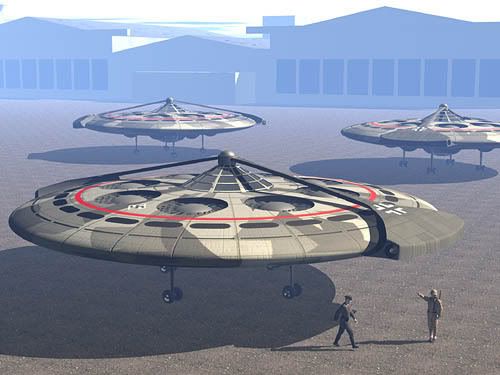
"Omega Disks" by Luca Oleastri

Here are the latest UFO Sightings reported to UFOs/Aliens.

03-07-07-Arkansas-Witness reports that a star-like object has appeared in his city for several weeks running. Witness says that unknown object is NOT a star, because it sits near horizon level with late afternoon clouds and disappears before night fall comes. Witness observed object through binoculars and it appeared to be flat or disc-shaped throwing out multi-colored light beams around it. The object does not move.

03-08-07-Florida-Early morning witness went outside to gather newspaper, and as he looked toward the Moon, he saw two star-like objects to his left near the Moon. The objects were in motion at a uniform speed. Now and then, one or the other object would fade from view, then reappear. After about 30 seconds, the objects were gone. Witness is certain they were not airplanes.

03-07-07-Illinois-A large silver object partially shrouded in clouds moved from North to South across the horizon near EW Tollway 88 and Route 39 Downers Grove. It could have been a blimp but it was too large and moved too quickly. It wasn't a plane... it had no wings. It moved southerly and then westerly and then disappeared. It was the strangest thing the witness had ever seen.

03-07-07-Maine-Witness was looking out of kitchen window and thought he saw the Moon but after looking out the other side of the house the Moon was there. Witness watched the object for about 5 minutes, and the object never moved. Finally, it simply vanished from the sky.

03-04-07-Missouri-Ex-Cop reports that as he walked outside, he noticed some lights in the sky. The color was like amber street lights, or vapor lights. The lights appeared to form a circular shape. They would come on and off in different sequences. Lights were about 5,000 feet altitude. Object was huge, states witness. The lights were obviously attached to some object, which moved off in an easterly direction. After about 15 minutes, witness again spotted objects in the western sky, but much further away.

03-07-07-Missouri-Witness wrote in asking for someone to investigate a UFO that was seen by the Jefferson City, Missouri, Cole County Sheriffs Department. After a sighting was called in to them, several deputies and state troopers arrived and saw the object. Witness overhead them calling in sighting to base. Friends of the witness heard it all on police scanner.

03-08-07-New York-Witness was asleep, and bed was next to a large window with the venetian blinds rolled up. At exactly 4:26 AM, witness woke up because of some sound, and saw a moving light through the window. He opened the window and screen to get a better look. He could see a contrail thousands of feet high extending from his location toward the Moon. Higher up, another contrail transversed the first, giving witness the idea that two objects had flown high above him. He had not seen anything like this before, and thinks the trails were related to the sound he heard.

Thursday, March 15, 2007

Harbin Ice and Snow World 2007 - From R Todd King's Blog

I was over at R Todd King's blog and saw these awesome photos and just had to share them here. There are also many more photos of beautiful snow sculptures from the 2003 and 2005 festivals for you to enjoy. So check 'em out!

______________________

Welcome to... Montreal after a snowstorm? No, this is “The 19th Annual China Harbin Sun Island International Snow Sculpture Art Fair” in Harbin, China. When I first attended this festival in 2003 and then visited again in 2005, the event was a purely Chinese affair; this 2007 festival was a cooperative effort with the city of Montreal, Canada, making it a very different festival from years past. Harbin’s Sun Island Park - a hundred acres along the north bank of the Songhuajiang, the river separating the park from the city’s downtown to the south - once again hosted the snow festival.

I arrived in Harbin earlier this day not knowing of the Canadian influence, and anxious to see the festival right away, I sped right past Sun Island Park’s driveway entrance without noticing the giant snow sculpture and models of maple leaves there. That would have struck me as odd, as Harbin has no maple trees. So my first hint that something unusual was going on did not come until after I entered the park’s west gate and discovered this series of trees, carved out of snow, sprouting branches of artificial maple leaves in full autumn color.

Past those non-Chinese maples, and then past this non-Chinese cavalry providing security for the snow festival...

...was this non-Chinese village. The road these visitors strolled had the very non-Chinese name of Saint Dennis Street. Clearly something different was happening at the festival from years past, and final confirmation of that came...

...when I noticed that all the village shop signs were in French. A little further along Saint Dennis Street, lines of Canadian flags like those in the first photograph began to appear, and I started to wonder if I was in Harbin at all.

Reassurance that I was truly still in China came with a visit to the village center. These very tall dragons were not made of snow; actually, they appeared to be covered in astroturf. Lines of alternating Chinese and Canadian flags appear on the continuation of Saint Dennis Street beyond. Everything I saw up to this point was completely different from the Harbin snow festivals of years past.

If you’re thinking of buying a home in this quaint village, check out the room sizes first; space appears rather tight. And if you do buy, make sure your home maintenance warranty lasts beyond spring.

Beyond the village, the snow festival appeared more like those of the past. Many snow sculptures celebrated the approaching Chinese New Year, which in 2007 brings the Year of the Pig. This is no ordinary pig year, however. It’s an event that occurs only once every sixty years: a Golden Pig Year. Despite the specialness of the occasion, no golden yellow snow was to be found at the festival. Thank goodness.

Déjà vu. If you saw my earlier sets of snow festival photographs, then this sculpture should look familiar: it’s a copy of the snow maiden appearing at the festival four years ago, somewhat smaller than the original. This one is not made of snow; the original sculpture proved so popular that Sun Island Park erected a permanent version, which must appear somewhat out of place in the middle of a Harbin summer.

This huge snow sculpture is of Norman Bethune, a Canadian doctor who came to China in 1938, became medical chief of Mao’s army fighting the Japanese, and trained thousands in China to become doctors and medical personnel. Though Bethune died only a year or so after arriving in China, Mao - who noted Bethune’s resemblance to Lenin, as you might have - considered him a hero for introducing modern medicine to China. All Chinese know of Norman Bethune; Mao wrote an essay about him that every child had to memorize during the Cultural Revolution, and Chinese schoolchildren today continue to learn about him. If you pick up a copy of Mao’s Little Red Book during a visit to China, you’ll find the essay there.

More entertaining were the nearby competition snow sculptures. Each year, the snow festival hosts a snow sculpting competition that draws teams from around the world. One reason I recommend that festival visitors come to Harbin in mid to late January - a couple of weeks after the January 5th opening every year - is because the results of the snow and ice sculpting competitions can then be seen. Here’s a simple but fun snow sculpture from the competition entitled “Christmas”. Notice the maple leaf models on the ground, again reflecting the Canadian theme; the park had an abundance of these, and apparently they lit up at night.

The sculptures can be stunning. This is one of two that took third place in the competition, a Russian entry called “Game”. In a garden, a hidden girl watches a boy playing with a dog. The style is wonderful - like characters in an animated movie - and amazingly consistent, expressive and pronounced for a sculpture made of snow. Look at the girl’s feet, one set of toes timidly covering the other.

Some of the sculptures, while remaining artful, tended to focus more on technical feats involving the structural stability of snow. For example, this sculpture, “Frostwork”, is completely hollowed out, with half the face missing...

...which does give an interesting glow to her face when the sunlight is right.

This snow sculpture too, entitled “The Home of Fish”, is hollowed out. Here, fish swim around inside a broken old diver’s helmet at the bottom of the sea. Ice is used to look like shards of broken glass. Some park workers told visitors that this sculpture had caved in due to unusually warm weather - more on that later - but this was not true; the sculpture was clearly designed to look this way, with sea plants even growing out through the broken portion of the helmet.

Another Russian entry, entitled “Northern Music”, took the other third-place prize in the snow sculpture competition. Honestly, I’m not sure why; it’s nice, but I considered a number of the other sculptures more deserving.

The one impressive flourish I noticed on “Northern Music” was the deer appearing on the player’s fingertips.

Another flute-playing maiden, this one actually made of snow, playing for park visitors. The competition snow sculptures tended to be around three meters - ten feet - in height. Over fifty teams took part in the competition this year.

The second-place sculpture of a Chinese bronze in the shape of a bull, entitled “Ancient Practice”, happened to sit right in front of “Game”. My understanding is that this sculpture was created by a team from a Harbin university that has now achieved second place at this competition three years in a row.

“Ancient Practice” viewed from behind, still looking dramatic. This did not appear to be a particularly complex sculpture in comparison with some of the others here, so I imagine it was the artistic quality that won it a prize.

“Waiting”, a Mongolian entry to the snow sculpture competition.

This absolutely amazing Russian entry, entitled “Fairy Tale of the Forest”, was the top prize winner at the snow sculpting competition this year. Another hollowed-out snow structure, it seems to defy gravity; the thin tree trunk characters surrounding the fairy leave the sculpture completely open on three sides and supported by nothing more than her hair.

“Fairy Tale of the Forest” viewed from the back left, again showing the vast openness of the sculpture and the reliance of the fairy’s hair for structural support. It seems egg-shell delicate, yet somehow remains standing. Notice that the tree trunks truly are characters in this sculpture, with branches like arms outstretched above their tiny heads.

Across a small frozen lake north of the competition sculptures was the largest snow sculpture ever created, a new Guinness World Records entry: 250 meters (over 800 feet) long, 28 meters (over 90 feet) high in parts, using more than 13 thousand square meters (nearly a half million cubic feet) of man-made snow. Though continuous, it actually consisted of two sculptures. The eastern half represented Niagara Falls and was frankly a rather boring sight, just vertical ridges of very static snow representing the wide waterfall. The western half, entitled “Crossing the Bering Strait”, was far more interesting with its depiction of First Nations people on the move. This shows part of that sculpture.

Detail of “Crossing the Bering Strait” viewed from a different angle. The detail is not nearly as extensive as the competition sculptures, but then again, we’re talking about three football field lengths of snow here.

The frozen lake itself, called the “Ten Thousand Person Skating Arena” during the snow festival, had little activity this day. Dogs here wait to pull sleighs of visitors across the ice.

Non-competition sculptures appeared throughout Sun Island Park as well, and though far less complex, some of them were impressive, like this boy with a toy.

The Canadian “Maple Leaf Ice Screen”, with another park sculpture. The blazing sun appearing over that sculpture turned out to be an unwelcome theme at the festival: the weather was unusually warm this year. Temperatures reached just below freezing - or in this case, just below melting - on the festival’s opening day, as it did a number of times in the preceding weeks. The only standing water in the park though came from festival officials nervous with sweat.

That is indeed Santa Claus on the door of this Chinese restaurant made of snow. During my late-January visit to Harbin, temperatures reached near melting again a number of times, though the sculptures and structures I saw seemed to show no ill effects. However, it topped freezing many days in early February, and I can only imagine the many problems that must have caused. Needless to say, warm weather is the worst thing that can happen to a snow and ice festival.

Another park snow sculpture, back near the Canadian village. During winter, people in Harbin often leave food they have stored up outside on their balconies to freeze. So a lot of people were complaining about the warm weather this year, since their food kept thawing out.

This was an unusual find - not the very tame snow slides, but the huge structure behind them. To my knowledge, this was the only replica of an actual site to appear at the snow festival: it’s the Château Frontenac in Quebec City.

The Canadian cavalry shown earlier on this page rides off into the sunset. They’re headed the right direction, because a mile or two ahead of them, just west of Sun Island Park, is the location of the Harbin Ice and Snow World getting ready to begin its activities for the night.


To view and read more about these sculptures, go HERE.


Technorati tags: , , ,

MUST SEE VIDEO!! Dr. Steven M. Greer's latest lecture over the Disclosure Project, CSETI, SEAS Power, and his latest book

"There is a major country in the world - G7 Country - that has decided to do this with us and has invited us to become the primary contactee to precipitate an event with these extraterrestrial vehicles with the full support of their air force, space command, everything, land and meet the leadership of this country with us facilitating this so that this can than be proximally disclosed to the world, and that what we are doing eminent - what we are working on eminently." - Dr. Steven M. Greer

This was taken from the Conscious Life Expo, in Los Angeles, February 11th, 2007. Everyone really needs to watch this. How much longer can we stick our heads in the sand?

EDIT: 9/5/07 - The video doesn't seem to be available any longer. I will keep an eye out for it and post it here again when I find it.


Technorati tags: , , , ,

Tuesday, March 13, 2007

Friday, March 9, 2007

Edgar Cayce Prophecies - Seven prophecies that came true

1. Edgar Cayce Foresees the Stock Market Crash of 1929
Edgar Cayce gave many readings on world affairs. The following warns of the impending stock market crash of 1929, months before it occurred: "These were given as to how the changes and how breaks. At the same time there was given that there was a division in the money conditions and positions. That fight has hardly begun. When this is an issue we may expect a considerable break and bear market, see? This issue being between those of the reserves of nations and of individuals, and will cause - unless another of the more stable banking conditions come to the relief - a great disturbance in financial circles. This warning has been given, see? Mind these are all in the position of being an influence in market conditions, and may turn either way, as the conditions come." Edgar Cayce reading 900-425 -- March 6, 1929

2. The 2004 Tsunami in the Indian Ocean
Perhaps the most amazing example of Cayce's predictive abilities was his prediction of the tsunami in the Indian Ocean. This event occurred on December 26, 2004, but Cayce saw it in April of 1941: "Watch for [strife] . . . in the Indian Ocean... Ye say that these are of the sea; yes-, for there shall the breaking up be . . ." Edgar Cayce reading, 3976-26 -- April 28, 1941

3. The Shifting of the Earth's Poles Has Begun, as Predicted by Edgar Cayce in 1936
In 1936 the following Cayce reading was given: "(Q): What great change or the beginning of what change, if any, is to take place in the earth in the year 2,000 to 2,001 A.D.? (A): When there is a shifting of the poles. Or a new cycle begins." Edgar Cayce reading 826-8 – August 11, 1936

NOVA recently reported startling discoveries about our planet's electromagnetic poles and fields in a program titled "Magnetic Storm." Scientists explained: "Two thousand miles beneath our feet is the Earth's molten core. Here a vast ocean of liquid iron generates an invisible force, the Earth's magnetic field. It's what makes our compasses point north. But it does a lot more: it helps to keep the Earth a living planet. Our neighbors, Venus and Mars, have only weak magnetic fields, which means they're unprotected from the deadly radiation sweeping through the solar system. The Earth, on the other hand, exists within a vast magnetic cocoon, a force-field that for billions of years has sheltered us on our journey through space."

But now scientists have made a startling discovery: it seems there's a storm brewing deep within the Earth, a storm that is weakening our vital magnetic shield. Peter Olson at Johns Hopkins University explained that "the Earth's magnetic field has been our protector for millennia, and now, it appears, it's about to go away." John Shaw of the University of Liverpool explains: "Pottery acts just like a magnetic tape recorder. It records the Earth's magnetic field when the pottery is first made." The intense heat in the kiln erases all the magnetic regions. But as the pot begins to cool, new magnetic regions form in the magnetite. As the regions re-form, they align with the Earth's magnetic field, just like compass needles. With millions of tiny magnets all pointing in the same general direction, the pot itself becomes slightly magnetic. Once it has cooled, the magnetism is locked in. "So if we take an ancient pot, when it cooled for the first time, it cooled in the Earth's ancient magnetic field and it became magnetized in that field. And of course, if the field's very strong, then the pot's strongly magnetized, and if the field's very weak, then the pot's weakly magnetized," Shaw explained. By examining pottery from prehistory to modern times, Shaw has discovered just how dramatically the field has changed in the last few centuries. "When we plot the results from the ceramics, this is what we see: gentle changes as we come forward in time over twelve thousand years – a gentle rise – and then a rapid fall, as we come towards the present day. The rate of change is higher over the last three hundred years than it has been for any time in the past five thousand. It's going from a strong field down to a weak field, and it's doing it very quickly." In three hundred years the field has fallen 10 percent, and the rate of decline is increasing. In just a few centuries it could be gone altogether.

In reading 826-1, Cayce indicated that the pole shift would become apparent in 2000 to 2001. The NOVA show revealed that the shift has indeed begun in the South Atlantic Ocean region, between Africa and South America. Here the north-south polarity is fluctuating back and forth, weakening the shield against solar radiation.

4. Convergence of Communications Companies
The following reading, given in 1929, is an interesting one on the convergence of large communications companies. These mergers did indeed occur. Also, Cayce's description of how varied channels of communications working in a more cooperative and structured manner has come to pass.

"(Q) Will the consolidations take place of the Communications company as given in 1928, American Tel & Tel - Int. Tel & Tel? (A) These combinations in communicative forces, as has been given will take place. As to when, and how, consider the conditions as prevent such a coalition at this time. Not only are there some of the laws as concerning same to be changed, but many of the larger holdings are to be won over by death even. In these changes, then, these are to be a gradual change, and will come about much in the same way and manner as the various Express companies came under the direct correlation physically in one form. Not that wars alone are to produce same, but the rumors of many of same, making the necessity of communications in the varied fields to come under one supervision, will make physical coalition. As to when, in time - it may be years, but all of the varied channels of communication will work one with another, and thus the varied commodities in their various divisions - as has been given - will offer an opportunity of investments as for holdings; and as for speculative interest - both those of the air and of physical contact, meaning those of Telegraph, Telephone, as well as Radio or Radial Operative Forces - including International American, Western Union, Westinghouse, and Radio. Edgar Cayce reading 257-36 -- April 7, 1929

5. There Was a Community of People Called the Essenes – and Cayce Described Them in Detail Years Before the Discovery of the Dead Sea Scrolls (1947 – 1956)
The first texts of the Dead Sea Scrolls were discovered in 1947- attributed to a then little- known sect called the Essenes. Cayce mentioned the Essenes in 171 different readings years before the first of the scrolls were unearthed. Here are a few excerpts:
"Before this we find the entity was during those periods when there was much turmoil in the land of Judea, when there was the announcing of the prophet, of the new teacher, and all Judea had gone out to John. The entity then was among those that had been of the students of the Essenes, and in direct connection with many that had been prophesying, had been searching the records of or for the coming of the new light to those that had been hemmed in by tradition and by the acts of peoples in a political and religious purpose in the land." Edgar Cayce reading 489-1 –January 17, 1934

Another: "In that experience we find the entity was a soul seeking through those associations and activities that brought the entity into the environ of the Grecian-Syrophenician surroundings; and in the activity in Palestine grew into womanhood there as one - that would be termed in the present - in the household of the counsellor of those that traded with the peoples in that land. With the advent of the Roman rule, the activities of such people became much more important; for there was the necessity of keeping a balance with both the Jew, the Greek and the Roman. When the ministry of the forerunner began, that of itself brought into the association of the entity many of those that were in that particular sect of peoples to whom the entity then was joined - the Essenes . . . [the city] then became a refuge or hospital for those that might become the teachers, the ministers, for the activities of the Essenes or teachers of which the Master was a member during the sojourn in Palestine." Edgar Cayce reading 489-3 – May 24, 1934

Finally, "In giving the biographical life of the entity Josie, much of those activities might be indicated that brought about those later relationships with Mary, the mother of Jesus. As has been outlined from here, there were those special groups of individuals who had made some preparations for the expected activities that were to come about during that particular period; especially those of the Essenes who had chosen the twelve maidens to indicate their fitness. This choice was to be made by those selections indicated by the spirit, and Josie was the daughter of Shem and Mephibosheth that was among these. This entity, Josie, was close to Mary when the selection was indicated by the shadow or the angel on the stair, at that period of consecration in the temple. This was not the temple in Jerusalem, but the temple where those who were consecrated

orshiped, or a school - as it might be termed - for those who might be channels. This was a part of that group of Essenes who, headed by Judy, made those interpretations of those activities from the Egyptian experience - as the Temple Beautiful, and the service in the Temple of Sacrifice. Hence it was in this consecrated place where this selection took place. Edgar Cayce reading 1010-17 –June 21, 1942

6. Blood as Diagnosis Tool
Cayce's prophetic gift was exhibited in many ways, including an ability to foresee developments in the field of medicine.

"(Q) Does the blood still show traces or effects of my bodily condition? (A)This is bettered, though there are still evidences of same in blood. For, as is seen, there is no condition existent in a body that the reflection of same may not be traced in the blood supply, for not only does the blood stream carry the rebuilding forces to the body, it also takes the used forces and eliminates same through their proper channels in the various portions of the system. Hence we find red blood, white blood and lymph all carried in the veins. These are only separated by the very small portions that act as builders, strainers, destroyers, or resuscitating portions of the system - see? Hence there is ever seen in the blood stream the reflections or evidences of that condition being carried on in the physical body. The day may yet arrive when one may take a drop of blood and diagnose the condition of any physical body." Edgar Cayce reading 283-2 -- November 10, 1927

7. La Niña and El Niño
Amazingly, on May 28, 1926, Edgar Cayce made a connection between temperature changes in deep ocean currents and weather changes in reading 195-29: "As the heat or cold in the various parts of the earth is radiated off, and correlated with reflection in the earth's atmosphere, this in its action changes the currents or streams in the ocean..." This reading was concerning the future of wheat crops and weather patterns, and Cayce's comments may be his version of what we've all come to know today as La Niña and El Niño. These are weather patterns that are a result of temperature changes in the deep currents of Earth's oceans. These changes in the temperature of ocean currents have had dramatic effects on our weather, as Cayce foresaw.

For more information on Edgar Cayce, go HERE.

Technorati tags: ,

Tuesday, March 6, 2007

Spontaneous Human Combustion

Spontaneous Human Combustion is a phenomenon in which a human body purportedly catches fire as a result of heat generated internally by some type of chemical reaction. This phenomena has been reported for hundreds of years. Indeed, belief in the past was that if a person possessed too much anger or drank too much brandy, he or she might burn to death internally - literally combusting into ash within a matter of minutes!

In 1996, several of the world's top fire experts came together to investigate some of the most renowned spontaneous human combustion cases. The most amazing factor in these cases was the fact that though of the bodies of the victims were burned almost completely (give or take a few intact limbs), the items surrounding them were left untouched and undamaged.

In a crematoria, where temperatures reach from 700 to 1,000 degrees, human bones are not destroyed - making cases of spontaneous combustion an even more mind-boggling phenomena. In the 1980's Dr. John de Haan reported that this phenomena is likely caused by the melting of body fat. This is known as the "wick effect," which makes human body fat literally burn like a candle. Because pigs have similar fat content to humans, Dr. Haan experimented by using a dead pig, wrapping it in a blanket with a small amount of petrol poured onto it, and placing it in a controlled indoor environment. He then set fire to it to simulate a human body being burned. Within 5 hours, the charred remains were identical to those in the spontaneous human combustion cases, with items placed in the same room untouched, other than a nearby television, which was warped from the heat - but not from the fire itself.

Dr. Haan's experiment revealed that a small flame can indeed consume a body through the help of burning fat. This study purportedly demonstrated how a person who has been knocked unconscious, unable to extinguish a flame, could be burned almost entirely through natural processes without attracting any attention to passersby or igniting anything else in the vicinity. The remaining limbs that may be left were reported to be due to the fat content in them not being as rich as the rest of the body, thereby making them less likely to burn.

The problem with this experiment - though it was quite innovative - was the fact that it completely disregarded the cases in which people have actually witnessed these types of events. There are records of people who experienced them first-hand and lived to tell their stories! These stories completely contradict the scientific explanation of the wick effect, in essence leaving this bizarre phenomenon an unsolved mystery! We LOVE unsolved mysteries at Mystical Blaze!!!

Pursuant to this, the rest of this section will be devoted to documented cases of Spontaneous Human Combustion, possible explanations, eyewitness reports, and any other pertinent facts that might shed some insight into this weird phenomena. If you or anyone you know has had any involvement in a case of Spontaneous Human Combustion, please feel free to contact us via the Message Board link below, or privately by E-Mail. As always, this site is a work in progress, so do Bookmark now and return soon, as pages are added daily.

1998 - SYDNEY, AUSTRALIA

August, 1998

On August 24 1998, Agnes Phillips mysteriously caught fire while unattended inside her daughter's car. Several people witnessed this event, and amazingly, the victim lived for a short time afterwards.

Agnes, who suffered from Alzheimer's Disease and lived in a nursing home, had been picked up that day by her daughter, Jackie Park, for a routine visitation. Jackie parked the car and left her sleeping mother inside while she quickly went into the store to pick up a few items. Shortly thereafter she noticed smoke billowing from the car, followed by an explosion of flames.

As the car became engulfed, a passerby managed to drag Agnes out of the car and extinguish the flames. Though she remained remarkably calm throughout the whole ordeal, Agnes did manage to utter the words "It's too hot... It's too hot!"

Agnes suffered severe burns to her chest, abdomen, arms, and legs, and died in the hospital a week later. Upon further investigation, Fire Inspector Donald Walsh claimed that he could not determine where the fire had originated, since the car had not been running. There was no trace of liquid accelerants, no faulty wiring, and neither Agnes or Jackie smoked. Inspector Walsh ruled out Spontaneous Human Combustion, and believed that this fire was the result of the "wick effect," totally disregarding the fact that this process takes a matter of hours to burn a human body.

The documentation in this case reveals that Agnes's body was severely burned within a matter of minutes, essentially eliminating any possibility of this event being caused by a "wick effect" type of fire, thereby making this a likely candidate for a true Spontaneous Combustion case in modern times.

1982 - LONDON, ENGLAND

September, 1982

In 1982, Jean Saffin, a 61 year old handicapped London woman, mysteriously burst into flames while resting on a wooden chair in the kitchen of her Edmonton home. Her father was nearby and witnessed this event.

Jean's father claims that he saw a flash of light out of the corner of his eye, turned to inquire, and was shocked to see that Jean was on fire. The flames engulfing Jean centered mainly around her face and hands, according to her father, who also reported that Jean never cried out or reacted, but rather remained calm while he frantically dragged her to a sink to try and stop the fire. With the help of a son-in-law, Jean was kept alive until the paramedics arrived.

Upon their arrival, the paramedics observed that despite the level of the fire and degree of the burns, the flames had done little damage other than to a relatively small area on Jean's red nylon cardigan. She was conscious and seemed to be aware of what was going on when first hospitalized, but she gradually deteriorated, and unfortunately never spoke again. Her burns were severe, and after 8 days, she lapsed into a coma and died.

The coroner held an inquiry into Jean's death, and no cause could be found for the fire. The officer in charge reportedly told Jean's family that he believed the cause to be Spontaneous Human Combustion due to the circumstances, i.e. the very rapid ignition and burning of human tissue, but that he would look ridiculous if he reported this as a matter of permanent record.

Source


Technorati tags: ,

Monday, March 5, 2007

Piri Re'is Map

Introduction

In 1929, a group of historians found an amazing map drawn on a gazelle skin.

Research showed that it was a genuine document drawn in 1513 by Piri Reis, a famous admiral of the Turkish fleet in the sixteenth century.

His passion was cartography. His high rank within the Turkish navy allowed him to have a privileged access to the Imperial Library of Constantinople.

The Turkish admiral admits in a series of notes on the map that he compiled and copied the data from a large number of source maps, some of which dated back to the fourth century BC or earlier.

Image


The Controversy

The Piri Reis map shows the western coast of Africa, the eastern coast of South America, and the northern coast of Antarctica. The northern coastline of Antarctica is perfectly detailed.

The most puzzling however is not so much how Piri Reis managed to draw such an accurate map of the Antarctic region 300 years before it was discovered, but that the map shows the coastline under the ice. Geological evidence confirms that the latest date Queen Maud Land could have been charted in an ice-free state is 4000 BC.

On 6th July 1960 the U. S. Air Force responded to Prof. Charles H. Hapgood of Keene College, specifically to his request for an evaluation of the ancient Piri Reis Map:

6, July, 1960
Subject: Admiral Piri Reis Map
TO: Prof. Charles H. Hapgood
Keene College
Keene, New Hampshire


Dear Professor Hapgood,
Your request of evaluation of certain unusual features of the Piri Reis map of 1513 by this organization has been reviewed.

The claim that the lower part of the map portrays the Princess Martha Coast of Queen Maud Land, Antarctic, and the Palmer Peninsular, is reasonable. We find that this is the most logical and in all probability the correct interpretation of the map.

The geographical detail shown in the lower part of the map agrees very remarkably with the results of the seismic profile made across the top of the ice-cap by the Swedish-British Antarctic Expedition of 1949.

This indicates the coastline had been mapped before it was covered by the ice-cap.
The ice-cap in this region is now about a mile thick.

We have no idea how the data on this map can be reconciled with the supposed state of geographical knowledge in 1513.

Harold Z. Ohlmeyer Lt. Colonel, USAF Commander

The official science has been saying all along that the ice-cap which covers the Antarctic is million years old.

The Piri Reis map shows that the northern part of that continent has been mapped before the ice did cover it. That should make think it has been mapped million years ago, but that's impossible since mankind did not exist at that time.

Further and more accurate studies have proven that the last period of ice-free condition in the Antarctic ended about 6000 years ago. There are still doubts about the beginning of this ice-free period, which has been put by different researchers everything between year 13000 and 9000 BC.

The question is: Who mapped the Queen Maud Land of Antarctic 6000 years ago? Which unknown civilization had the technology or the need to do that?

It is well-known that the first civilization, according to the traditional history, developed in the mid-east around year 3000 BC, soon to be followed within a millennium by the Indus valley and the Chinese ones. So, accordingly, none of the known civilizations could have done such a job. Who was here 4000 years BC, being able to do things that NOW are possible with the modern technologies?

All through the Middle Ages were circulating a number of sailing charts called "portolani", which were accurate maps of the most common sailing routes, showing coastlines, harbors, straits, bays, etc. Most of those portolani focused on the Mediterranean and the Aegean seas, and other known routes, just as the sailing book which Piri Reis himself had written.

But a few reported of still unknown lands, and were circulating among few sailors who seemingly kept their knowledge about those special maps as hidden as they could. Columbus is supposed to have been one of those who knew these special sailing charts.

To draw his map, Piri Reis used several different sources, collected here and there along his journeys. He himself has written notes on the map that give us a picture of the work he had been doing on the map. He says he had been not responsible for the original surveying and cartography. His role was merely that of a compiler who used a large number of source-maps. He says then that some of the source-maps had been drawn by contemporary sailors, while others were instead charts of great antiquity, dating back up to the 4th century BC or earlier.

Dr. Charles Hapgood, in his book Maps of the Ancient Sea Kings (Turnstone books, London 1979, preface), said that:

It appears that accurate information has been passed down from people to people. It appears that the charts must have originated with a people unknown and they were passed on, perhaps by the Minoans and the Phoenicians, who were, for a thousand years and more, the greatest sailors of the ancient world. We have evidence that they were collected and studied in the great library of Alexandria (Egypt) and the compilations of them were made by the geographers who worked there.

Piri Reis had probably come into possession of charts once located in the Library of Alexandria, the well-known most important library of the ancient times.

According to Hapgood's reconstruction, copies of these documents and some of the original source charts were transferred to other centers of learning, and among them to Constantinople.

Then in 1204, year of the fourth crusade, when the Venetians entered Constantinople, those maps begun to circulate among the European sailors.

Most of these maps - Hapgood goes on - were of the Mediterranean and the Black sea. But maps of other areas survived. These included maps of the Americas and maps of the Arctic and Antarctic Oceans. It becomes clear that the ancient voyagers travelled from pole to pole. Unbelievable as it may appear, the evidence nevertheless indicates that some ancient people explored Antarctic when its coasts were free of ice. It is clear too, that they had an instrument of navigation for accurately determining the longitudes that was far superior to anything possessed by the peoples of ancient, medieval or modern times until the second half of the 18th century. [...]

This evidence of a lost technology will support and give credence to many of the other hypothesis that have been brought forward of a lost civilization in remote times. Scholars have been able to dismiss most of those evidences as mere myth, but here we have evidence that cannot be dismissed. The evidence requires that all the other evidences that have been brought forward in the past should be re-examined with an open mind." (Ibid.)

In 1953, a Turkish naval officer sent the Piri Reis map to the U.S. Navy Hydrographic Bureau. To evaluate it, M.I. Walters, the Chief Engineer of the Bureau, called for help Arlington H. Mallery, an authority on ancient maps, who had previously worked with him.

After a long study, Mallery discovered the projection method used. To check out the accuracy of the map, he made a grid and transferred the Piri Reis map onto a globe: the map was totally accurate. He stated that the only way to draw map of such accuracy was the aerial surveying: but who, 6000 years ago, could have used airplanes to map the earth??

The Hydrographic Office couldn't believe what they saw: they were even able to correct some errors in the present days maps!!

The precision on determining the longitudinal coordinates, on the other hand, shows that to draw the map it was necessary to use the spheroid trigonometry, a process supposedly not know until the middle of 18th century.

Hapgood has proved that the Piri Re'is map is plotted out in plane geometry, containing latitudes and longitudes at right angles in a traditional "grid"; yet it is obviously copied from an earlier map that was projected using spherical trigonometry! Not only did the early map makers know that the Earth was round, but they had knowledge of its true circumference to within 50 miles!

Hapggod had sent his collection of ancient maps (we will see the Piri reis map was not the only one...) to Richard Strachan, at the Massachusetts Institute of Technology. Hapggod wanted to know exactly the mathematical level needed in order to draw the original source maps. Strachan answered in 1965, saying that the level had to be very high.

In fact Strachan said that in order to draw such maps, the authors had to know about the spheroid trigonometry, the curvature of the earth, methods of projection; knowledge that is of a very high level.

View Piri Reis map with projected latitudes and longitudes:

The way the Piri Reis map shows the Queen Maud land, its coastlines, its rivers, mountain ranges, plateaus, deserts, bays, has been confirmed by a British-Swedish expedition to Antarctic ( as said by Olhmeyer in his letter to Hapggod); the researchers, using sonar and seismic soundings, indicated that those bays and rivers etc, were underneath the ice-cap, which was about one mile thick.

Charles Hapggod, in 1953, wrote a book called "Earth's shifting crust: a key to some basic problems of earth science", where he made up a theory to explain how Antarctic had been ice-free until year 4000 BC. (visit the Bibliography )
The theory summing up is as follows:
The reason Antarctic was ice-free, and therefor much warmer, it is to be found in the fact that, at one time, its location wasn't the south pole. It was located approximately 2000 miles further north. Hapgood says this "would have put it outside the Antarctic Circle in a temperate or cold temperate climate".

Read more information about Pole Shifting.

The reason why the continent moved down to its present location has to be found in a mechanism called "earth-crust-displacement". This mechanism, not to be confused with the plate-tectonics or the continental drift, is one whereby the lithosphere, the whole outer crust of the earth "may be displaced at times, moving over the soft inner body, much as the skin of an orange, if it were loose, might shift over the inner part of the orange all in one piece". (Charles Hapgood, "Maps of the ancient sea-kings", cited, visit the Bibliography for more info).

This theory was sent to Albert Einstein, which answered to Hapgood in very enthusiastic terms. Though geologists did not seem to accept Hapgood's theory, Einstein seemed to be as much open as Hapgood saying:

"In a polar region there is a continual deposition of ice, which is not symmetrically distributed about the pole. The earth's rotation acts on these unsymmetrically deposited masses, and produces a centrifugal momentum that is transmitted to the rigid crust of the earth. The constantly increasing centrifugal momentum produced in this way will, when it has reached a certain point, produce a movement of the earth's crust over the rest of the earth's body...." (Einstein's foreword to "Earth's shifting crust" p.1)

Anyway, whether Hapgood's theory is correct, the mystery still thrills.

The Piri Reis map is something which is not supposed to exist. I mean that by no means there was supposed to be anyone that far back in time able to draw a map of such precision; in fact the relative longitudinal coordinates are totally accurate, as stated by Official studies on the map that we saw above.

And this is a demonstration of impossible technology: the first instrument to calculate the longitude in a approximately correct way has been invented in 1761 by the english John Harrison.

Before there was no way to calculate the longitude in an acceptable way: there could be errors of hundreds kilometers....

And the Piri Reis map is just one of several which show supposedly unknown lands, impossible knowledge, precision which still today would surprise........

In fact Piri Reis himself admitted he based his map on way older charts; and those older charts had been used as sources by others who have drawn different maps still of great precision.
Impressive is the "Dulcert's Portolano", year 1339, where the latitude of Europe and North Africa is perfect, and the longitudinal coordinates of the Mediterranean and of the Black sea are approximated of half degree.

An even more amazing chart is the "Zeno's chart", year 1380. It shows a big area in the north, going up till the Greenland; Its precision is flabbergasting. "It's impossible" says Hapgood "that someone in the fourteenth century could have found the exact latitudes of these places, not to mention the precision of the longitudes..."

Another amazing chart is the one drawn by the Turkish Hadji Ahmed, year 1559, in which he shows a land stripe, about 1600 Km. wide, that joins Alaska and Siberia. Such a natural bridge has been then covered by the water due to the end of the glacial period, which rose up the sea level.

Oronteus Fineus was another one who drew a map of incredible precision. He too represented the Antarctic with no ice-cap, year 1532.

There are maps showing Greenland as two separated islands, as it was confirmed by a polar French expedition which found out that there is an ice cap quite thick joining what it is actually two islands.

As we saw, many charts in the ancient times pictured, we might say, all the earth geography. They seem to be pieces of a very ancient world wide map, drawn by unknown people who were able to use technology that we consider to be a conquer of the very modern times.

When human beings were supposed to live in a primitive manner, someone "put on paper" the whole geography of the earth. And this common knowledge somehow fell into pieces, then gathered here and there by several people, who had lost though the knowledge, and just copied what they could find in libraries, bazaars, markets and about all kind of places.

Hapggod made a disclosure which amazingly lead further on this road: he found out a cartographic document copied by an older source carved on a rock column, China, year 1137. It showed the same high level of technology of the other western charts, the same grid method, the same use of spheroid trigonometry. It has so many common points with the western ones that it makes think more than reasonably, that there had to be a common source: could it be a lost civilization, maybe the same one which has been chased by thousands years so far?

Summary

The Piri Re'is map is often exhibited in cases seeking to prove that civilization was once advanced and that, through some unknown event or events, we are only now gaining any understanding of this mysterious cultural decline. The earliest known civilization, the Sumerians in Mesopotamia, appear out of nowhere around 4,000 B.C. but have no nautical or maritime cultural heritage. They do, however, speak reverently of ancestral people who were like the "gods" and were known as the nefilim.

Here is a summary of some of the most unusual findings about the map:

  • Scrutiny of the map shows that the makers knew the accurate circumference of the Earth to within 50 miles.

  • The coastline and island that are shown in Antarctica must have been navigated at some period prior to 4,000 B.C. when these areas were free of ice from the last Ice Age.
  • The map is thought to be one of the earliest "world maps" to show the Americas. Early scholars suggested that it showed accurate latitudes of the South American and African coastlines - only 21 years after the voyages of Columbus! (And remember, Columbus did NOT discover North America - only the Caribbean!) Writing in Piri Re'is own hand described how he had made the map from a collection of ancient maps, supplemented by charts that were drawn by Columbus himself. This suggests that these ancient maps were available to Columbus and could have been the basis of his expedition.
  • As can be seen below, an azimuthal projection ( looking at the globe from a point above the globe), from the point above Cairo, Africa (Egypt) shows that the Piri Reis map corresponds more or less with the lower right quarter of this map if one rotates it some 20 degrees counter clockwise.

Image
Image

The contours from the Piri Reis map (top image),
and an azimuthal projection of the real globe (bottom image),
show very similar distortions.

  • Piri Re'is own commentary indicates that some of his source maps were from the time of Alexander the Great (332 B.C.).
http://www.world-mysteries.com/sar_1.htm

Technorati tags: , , ,

U.N. to debate contact with extraterrestrial civilizations


U.N. General Assembly Now Has Resolution To Establish United Nations Decade Of Contact & Diplomatic Relations With E.T.s

For the first time in almost 27 years, the United Nations General Assembly will be debating the issue of establishing diplomatic relations with advanced Extraterrestrial Civilizations that may now be visiting Earth.

On December 16, 2005, a Resolution to establish a United Nations Decade of Contact was formally transmitted to the incoming President of the General Assembly, H.E. Jan Eliasson of Sweden by the Institute for Cooperation in Space (ICIS), a Non-Governmental Organization. President Eliasson was Sweden's Ambassador to the United Nations from 2000 to 2005.

Almost to the day twenty-seven years ago, on December 18, 1978, the United Nations General Assembly voted to approve decision 33/426, inviting U.N. Member States "to take appropriate steps to coordinate on a national level scientific research and investigation into extraterrestrial life, including unidentified flying objects, and to inform the Secretary-General of the observations, research and evaluation of such activities."

Then U.S. President Jimmy Carter then supported the U.N. General Assembly's decision. Carter himself had a close Encounter of the First Kind with a UFO (Night Light) in October 1969, in the company of 10 members of the Leary, Georgia Lion's Club while he was running for Governor of Georgia. Four years later, while Governor of Georgia, Carter filed a public UFO sighting report, dated September 18, 1973.

UNITED NATIONS DECADE OF CONTACT

Former Canadian Minister of Defence, Hon. Paul Hellyer has requested that the Canadian Parliament hold hearings on the issue of relations with Extraterrestrial civilizations. On September 25, 2005, at the Toronto Exopolitics Symposium held at Convocation Hall, University of Toronto, former Minister of National Defence Hellyer stated: "UFOs, are as real as the airplanes that fly over your head."

He stated, "The United States military are preparing weapons which could be used against the aliens, and they could get us into an intergalactic war without us ever having any warning. The time has come to lift the veil of secrecy, and let the truth emerge, so there can be a real and informed debate, about one of the most important problems facing our planet today."

Over 630,000 registered journalists and 283,000 registered media outlets world-wide have downloaded a November 24, 2005 Thanksgiving Day (USA) Yahoo News story of Mr. Hellyer's request to the Canadian Parliament.

Mr. Hellyer, Canada's former Minister of Defence, supports a United Nations Decade of Contact. In the introduction to a recent book, EXOPOLITICS: POLITICS GOVERNMENT AND LAW IN THE UNIVERSE, by ICIS International Director Alfred Lambremont Webre, Mr. Hellyer writes, "To turn us in the direction of re-unification with the rest of creation Alfred Lambremont Webre is proposing a 'Decade of Contact' - an 'era of openness, public hearings, public funded research, and education about extraterrestrial reality.' That could just be the antidote the world needs to end its greed-driven, power-centered madness."

A United Nations Decade of Contact has four Objectives: (1) DISCLOSURE - Governmental disclosure related to Extraterrestrial Presence; (2) DECADE OF CONTACT - Public funding of a 10 year process of public education and research about the Extraterrestrial Presence; (3) DISARMAMENT - A permanent ban on all space-based weapons and warfare in space through a Space Preservation Treaty Conference; (4) DIPLOMACY - Public Interest UNITED NATIONS Diplomacy with ethical Off-Planet Cultures now visiting Earth.

The Disclosure Project, a U.S.-based non-profit organization, on May 9, 2001, held a press conference at the National Press Club in Washington, D.C. in which numerous high-level military-intelligence, governmental and private sector witnesses publicly described experiences and evidence establishing that advanced Extraterrestrial civilizations are interacting with our terrestrial civilization at this time.

A military-intelligence spying technology known as "remote viewing" originally developed at Stanford Research Institute in the mid-1970s by Dr. Hal Puthoff and Russell Targ has yielded replicable data regarding the existence of Off-Planet cultures now visiting Earth.

On May 20, 2005, Brazil, a major U.N. Member Nation took official measures in support of a United Nations Decade of Contact. The Brazilian Air Force (FAB) openly allowed examination of classified UFO documents in several military facilities in Brasilia, the Federal Capital.

The United Nations General Assembly has voted in favor of a treaty banning weapons and warfare in space. The last time a United Nations vote was held on this issue was on December 8, 2003, when the General Assembly voted 174 - 0, with four lone abstentions (Israel, Marshall Islands, Federated States of Micronesia, United States of America).

Reached for comment, one Non-Governmental spokesperson stated, "We are certain 2006 will be a banner year for official disclosure of an advanced Extraterrestrial presence, and for the beginnings of a United Nations Decade of Contact."

CONTACT:

Institute for Cooperation in Space(ICIS) - 1-877-266-7337
Alfred Lambremont Webre, JD, MEd
http://www.peaceinspace.net

Non-Governmental Organizations Contact:

Toronto, Canada: Victor Viggiani, Exopolitics Toronto Symposium
Tel: 905-278-5628
http://www.exopoliticstoronto.com

Washington, D.C.: Dr. Steven Greer, The Disclosure Project
Tel: (540) 456-8302 (Office)
http://www.disclosureproject.org

UNITED NATIONS GENERAL ASSEMBLY:
http://www.un.org/ga/60/

http://www.prweb.com/releases/2006/1/prweb326765.htm


Source: http://www.ufodigest.com/unufo.html


Technorati tags: , , , , , ,